Getting Back Into Your Routine After Summer (Without Pretending August Didn’t Happen)
Summer won. It always does. Here’s the guilt-free, science-backed plan for getting your sleep, energy and focus back this September.
In June, I wrote a post about preparing for summer excess. I assembled a recovery kit. I briefed my liver. I told anyone who would listen that this year, I would be meeting summer as an equal.
Summer, for the record, did not read the post.
The kit helped — the magnesium spray and the tart cherry juice have earned permanent bedside-table status — but the beach volleyball still happened, the rosé still happened, and at a wedding in July I attempted a dance move that a medical professional later described as “ambitious.” It is now late August. My routine and I are no longer on speaking terms, and my sleep tracker has started sending what I can only describe as welfare checks.
So here’s the sequel: not how to survive a summer — how to come back from one.
The good news is that September is quietly the best month of the year for this. Behavioural scientists call it the “fresh start effect”: we’re measurably better at sticking to new habits when they start at a meaningful landmark — a birthday, a Monday, a new school year. September is the entire country’s Monday. Cooler evenings, new-pencil-case energy, everyone silently agreeing to pretend they’ve always been disciplined. Use it.
One disclosure before we start. Last time, I deliberately left every VAION product off the list so nobody could accuse us of talking our own book. (People screenshotted it. I was thrilled.) This time, two of ours do appear — because getting people back into a routine is quite literally what they’re for — and in fairness, I’ll be harder on them than on anything else here. Scepticism goggles on.
1. Fix your wake time, not your bedtime
The damage: An August that hit 38.1°C at Kew Gardens and served up official “tropical nights” — the ones where it never drops below 20°C outside and my bedroom settled at a defiant 29°C around midnight. Add barbecues that ended at an hour I associate with airport check-ins, and a body clock that now believes it lives somewhere considerably more glamorous.
The fix: Don’t start by forcing an earlier bedtime — start by fixing your wake time. Same alarm, seven days a week, then get daylight into your eyes within the first hour. Bedtime follows on its own within about a week.
How it helps your body: Your circadian rhythm — the internal clock that decides when you feel sleepy and when you feel sharp — is set primarily by morning light, not by willpower at 10.30pm. Light hitting your eyes anchors the clock, which times your evening melatonin release properly. Meanwhile, being awake builds sleep pressure through a compound called adenosine, and waking at a consistent time means that pressure peaks at a consistent hour. You can’t force yourself to fall asleep at 10.30 after a summer of 1ams. You can drag your mornings back into line and let the evenings surrender on their own.
Top tip: Alarm on the other side of the room, and coffee only after you’ve stood outside for ten minutes — the daylight does more for your body clock than the caffeine does. And yes, we sell Sleep Patches (£18, or £15 a month on subscription), and yes, they’ve been doing shifts on my own arm since July — but they’re the supporting act, not the headliner. A patch applied to someone who got morning daylight has something to work with; a patch applied to someone doomscrolling at 1am is doing crisis management. The BetterYou magnesium spray from the June post also remains on my bedside table, and remains excellent.
2. Repay the cellular debt (this is the bit where I declare an interest)
The damage: Invisible, which is why it’s easy to ignore. But the late nights, the sun and the drinks weren’t separate little sins — they were all drawing on the same account.
How it helps your body: That account is NAD+, a coenzyme found in every cell you own, and September is when the statement arrives. Your cells need NAD+ to convert food into usable energy. When you drink, the enzymes that break alcohol down consume NAD+ as they work. When sun damages the DNA in your skin cells, the repair enzymes that fix it — they’re called PARPs, and they are very busy in August — spend NAD+ too. And your levels were already declining gradually with age before summer showed up with its invoice. In other words: a great August writes cheques against precisely the account that keeps your energy, repair and focus solvent. The reset is about topping the account back up.
The fix: Some of it is free — the sleep, food and movement in the rest of this post all support your body’s own NAD+ production. Our contribution is the direct route: NAD+ Injection Pens deliver a painless daily microdose (from £370, or £300 a month on subscription), and the NAD+ Nasal Spray does the daily-habit part without a needle in sight (£199, or £150 a month on subscription, plus a one-off £25 sign-up fee — see, told you I’d be harder on us).
Now, as promised, the hard-on-our-own-products bit: that is proper money, and I won’t pretend otherwise. If the budget says no, everything else in this post is free or nearly free and will still genuinely move you forward — NAD+ supplementation is the accelerant, not the engine. Your body also builds NAD+ from precursors in ordinary food, and we’ve written a whole post on which foods are richest in them, which costs you nothing but a trip to the supermarket.
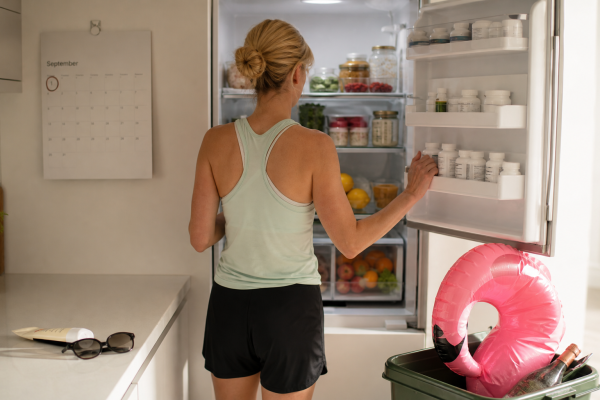
Top tip: Whatever you choose, consistency beats heroics — a small daily dose attached to an existing habit does more than a sporadic large one. And note: NAD+ lives in the fridge, not the cupboard. Mine sits in the door shelf next to the Symprove, which makes the fridge the most health-conscious appliance in my flat and means my routine starts the moment I open it — no remembering required. Begin in the first week of September, while the fresh-start effect is doing half the work for you.
By the way… to help with the September Reset, here is a coupon code for my readers: code RESET15 takes 15% off until Sunday 13 September.
3. Eat like someone who owns a fridge
The damage: Fourteen consecutive days of eating like you’re on death row, followed by three weeks of “using things up,” which is somehow worse.
The fix: No detoxes — nothing sold in tea form is coming to rescue you. Just rebuild the boring scaffolding: protein at breakfast, vegetables with actual fibre in them, and meals that happen at mealtimes rather than continuously between noon and midnight.
How it helps your body: A summer of holiday eating knocks your gut microbiome sideways, and fibre is what feeds the good bacteria back into the majority. Protein early in the day steadies your appetite hormones, which spares you the 4pm biscuit ambush. And regular mealtimes are themselves a circadian signal — your gut has a body clock too, and it would like to know what time zone it’s in. (The Symprove from the June post is still in my fridge door, still being taken ten minutes before anything else, still the least glamorous and possibly most useful thing I do all day.)
Top tip: Don’t overhaul your diet; overhaul your shopping list. The version of you at 7pm on a Wednesday will eat whatever is nearest, so make sure the nearest thing isn’t left over from August’s hospitality programme.
4. Re-enter exercise like a returning astronaut
The damage: Sudden, unscheduled athleticism in July (see: volleyball, the wedding), followed by five weeks of nothing more strenuous than carrying a fan between rooms.
The fix: Gentle re-entry. Two or three easy sessions a week — brisk walks, an unheroic jog, a swim — for the first fortnight, before you attempt anything your calves would classify as a betrayal.
How it helps your body: Fitness fades faster than enthusiasm, which is exactly the mismatch that causes September injuries — your cardiovascular system remembers summer fondly, but your tendons and muscles adapt more slowly and hold grudges. Easy, consistent movement rebuilds the base, improves sleep quality the same night, and sharpens focus through better blood flow to the brain. The tart cherry juice from the recovery kit earns its place again here — the research on reduced muscle soreness is strongest when you start it a few days before the exercise, not the morning after, when you are bargaining with the stairs.
Top tip: Book the sessions into your calendar like meetings. A routine that exists only as an intention is not a routine; it’s a mood.
5. Make the routine too small to fail
The damage: Twenty consecutive summers of September plans that were, in hindsight, entire lifestyle transplants. My success rate with those is zero.
The fix: Shrink each habit until it’s slightly embarrassing. Not “meditate daily” — two minutes after brushing your teeth. Not “get fit” — trainers by the door, walk before the first meeting. Attach every new habit to something you already reliably do.
How it helps your body (and brain): Habits form through repetition, not intensity — your brain automates whatever you repeat in the same context, which is why the anchor matters more than the ambition. Each tiny completed habit also delivers a small, real sense of control, and after a summer of glorious chaos, that feeling compounds fast. The routine isn’t the punishment for the fun. It’s what makes you the kind of person who can afford the fun next summer.
Top tip: Write the routine down as “after X, I do Y” sentences. It feels bureaucratic. It works.
The honest bit
None of this is atonement, because August doesn’t need atoning for. The long lunches and the late nights with people you love are health too — arguably the kind that matters most — and I’d make almost every one of those choices again, including, on reflection, the dance move.
But the fun and the routine are two halves of the same year, and September is the hinge. Sleep, water and the occasional vegetable remain undefeated, everything we sell is a supporting act to those three, and no product — ours very much included — will outrun a routine you refuse to restart.
My own September plan is written down, embarrassingly small, and stuck to the fridge. Based on twenty years of data, there’s every chance it’s in pieces by half-term. But that was never the real test. The real test is whether you get back on — and that, I can finally say with confidence, I’m excellent at.
Nothing in this post is medical advice — if you have a health condition, are pregnant or take medication, check with a professional before changing your routine or adding supplements. Prices checked August 2026 and may change. Vaion Health has no commercial relationship with the non-VAION brands mentioned; we just rate them. The VAION products, we obviously do have a commercial relationship with. That’s rather the point.